


Two Expats, One Language: Learning German in Germany
Five years in my current German city, after a long stretch in Switzerland, and my German has been assembled rather than acquired: a little from paperwork, a lot from daily life, several group courses, plenty of failed attempts and a few restarts. Somewhere in all that, the language started to hold. At Frankfurt Airport the immigration officer looks at my residence permit and says something in German, and I answer in German. At the doctor I follow the conversation, ask what I need to ask, and leave with most of it understood.
The moment that stays with me, though, was in a supermarket. A tourist could not make herself understood at the till, and I stepped in and translated. It was a small thing. It also felt like the point of all those years — not simply the ability to communicate, but the sense of belonging to a place rather than passing through it.
There is still a long way to go. I want more fluency at work and at home, especially in the pharmaceutical and healthcare sector where I work, and I want to stop composing sentences in my head and simply speak. That is what led me to try one-to-one tutoring on Preply.
What a good tutor match changes
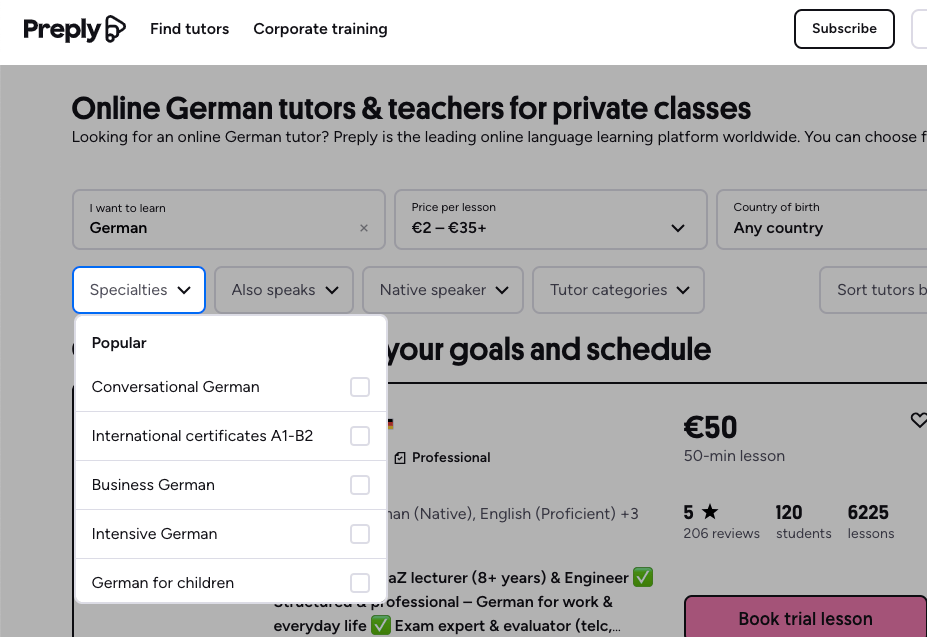
The personalisation was the first surprise. Preply matches students to tutors using goals, availability, time zone and learning preferences, not just a level. My trial class was twenty-five or fifty structured minutes of conversation rather than grammar drills. The platform also keeps vocabulary and lesson notes in one place and gives you something to practise between sessions, which matters more than it sounds: the work between lessons is where the language settles. It felt less like buying a course and more like finding the right person to learn with.
Language learning, I have come to believe, is not a solo activity. Progress needs two people.
Khushboo's story: four years in, still waiting for the click
I mentioned Preply to a friend, Khushboo, who has lived in Germany for more than four years. She has passed her B1 exam. On paper that should be enough, but anyone who has sat a language exam knows that passing and conversing are different achievements.
"Even after passing B1, I still don't feel confident enough. I notice my own mistakes while speaking, and that makes me hesitant. It affects my confidence."
She had already tried apps, online classes, in-person courses and exam preparation. They did their job in the narrow sense: she passed. Something was always missing, though. "They helped me pass the exam, but not have a real conversation."
What she wanted this time was different. No rigid curriculum, no embarrassment about her level — just a good rapport with a real person and lessons that reflected her actual life: the office, the doctor's surgery, the German that comes up on a Tuesday afternoon rather than in an exam hall.
Preply matched her with a tutor whose style suited her personality: warm, flexible and genuinely interested in what she needed. Every session is built around her life rather than a textbook. "We choose different topics every time. It feels like a conversation, not a class."
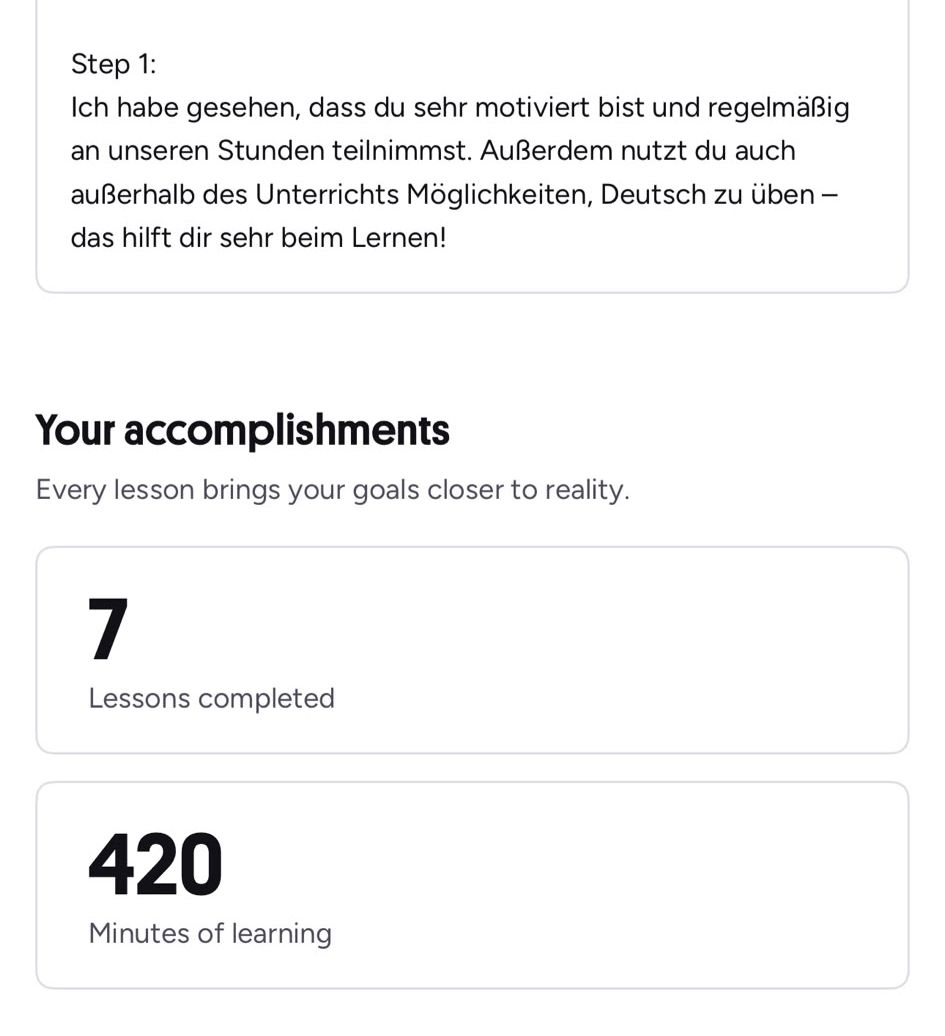
The tutor has noticed the commitment too. In written feedback after a recent lesson she wrote: "I can see your strong motivation, and you attend our lessons regularly." She added that Khushboo also practises German outside class, which "really helps with learning."
Seven lessons, 420 minutes
Then came the test no exam could set. Khushboo had seen her doctor the month before. On this visit, in the same practice, something had shifted: she was speaking more freely and reaching for words without freezing. The doctor spotted it before she mentioned it.
"You are speaking really well this time. That's impressive."
That unplanned remark, in the middle of an ordinary appointment, was what she had been working towards. Not a certificate or a score, but a doctor in Germany telling her, in German, that she was getting somewhere.
Her ambition has grown since. She wants to handle job interviews in German, to communicate naturally, to walk into a room without feeling the language working against her. The lessons are built for that: practical, purposeful and on her own terms.
I asked what fluency would feel like. She pictured a group of people talking and laughing together in German, every one of them at ease. Just now, she said, it still feels as though everything is bouncing around in her head. "But everything takes time, and everything comes with practice."
Her advice for anyone hesitating is blunt: go into the lesson with confidence, make mistakes on purpose, and let someone correct them. "Unless you make mistakes and someone highlights them, you will keep repeating them. So my advice is: make more mistakes, and let someone correct you."
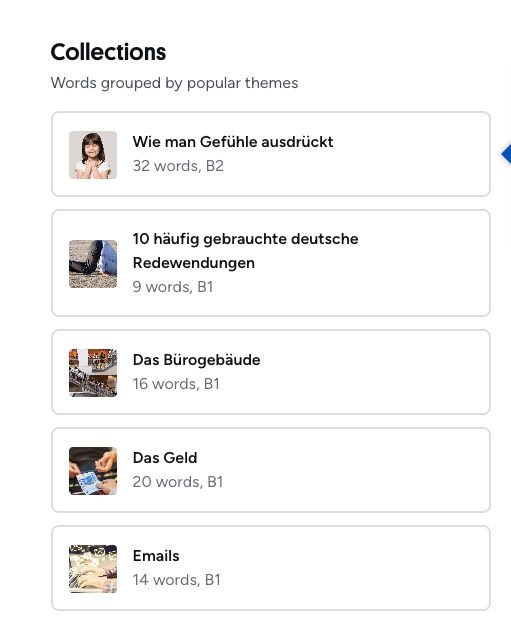
What progress actually looks like
Listening to her, I kept returning to that supermarket till. I had been the stuck one often enough, fumbling something simple or helpless in something complicated. What neither of us found in an app or an exam class was a person who adapts to you, notices your effort, chooses topics that belong to your life and confirms the successes you have stopped noticing yourself.
Progress rarely happens alone. It needs a tutor who pays attention, a friend who suggests you try, a doctor who notices the difference, and a stranger at a checkout who gives you the chance to show up for someone else. Sometimes it needs more than two.
Khushboo has a job interview to prepare for. I have work meetings to navigate in a new language. Both of us are still finding our footing — and finding it.
This is a sponsored post created in partnership with Preply. All opinions and experiences are genuine.
Discover more from Europe Diaries
Subscribe to get the latest posts sent to your email.
Sonia
I can definitely relate to the idea that true fluency will come when I can sit in a group of people and talk and exchange ideas without having to think of the words. I’m in the midst of learning another language now and, though I can get by, I am looking forward to getting to the stage of full fluency.