
Two Berlins in One Afternoon: A Cold War Walk
The train was called the Frankfurter Ring, and I was pleased with myself for finding it. It would take a while from Wedding, but I was going to see East Berlin. What had the city actually been like when it was cut in two? How did people live it, and how did they cross, and were they even allowed to? I had been in Berlin a few days by then and was already half looking for reasons to move there — the street art and the alternative side of the city had done their work, and now I wanted the history and the architecture.
So I booked a walking tour about the division, run by a docent from Context Travel — they are all PhDs or specialists in their field — and arranged to meet at Frankfurter Allee.
The wrong Frankfurter
Frankfurter Ring, it turns out, is not Frankfurter Allee. I worked this out on the platform, did the arithmetic on walking versus being late, and concluded that walking was hopeless. Another U-Bahn, then. When I came up the steps, the Frankfurter Tor was directly in front of me, which felt like an apology from the city.

It is enormous, and unlike most of the buildings I had seen in Berlin. The Tor sits on Karl-Marx-Allee, and Lucia, our guide, explained that this was the centre of East Berlin under the Soviet-backed German Democratic Republic. The two towers flanking the road really do read as a gate into the eastern half of the city.

Worker palaces in wedding-cake style
Walking east along the boulevard, I noticed the same tone repeating: high ceilings, tiled facades, shared balconies on the residential blocks. This was socialist architecture, and the housing has been called worker palaces in wedding-cake style — tall, tiled, and very like what was being built across the Soviet Union.
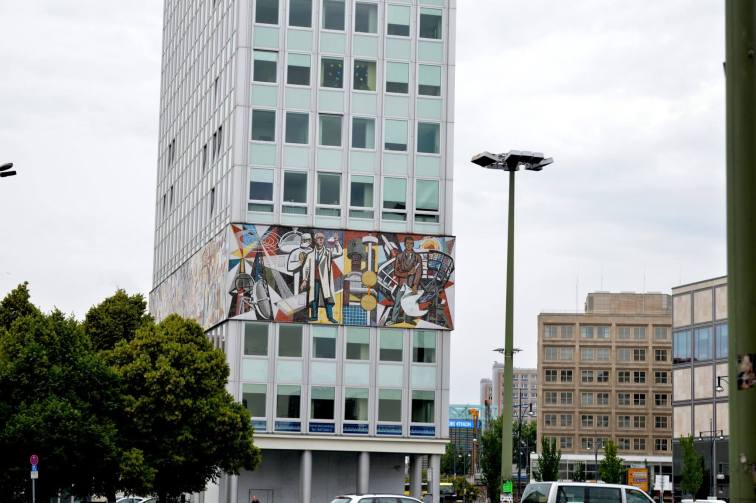
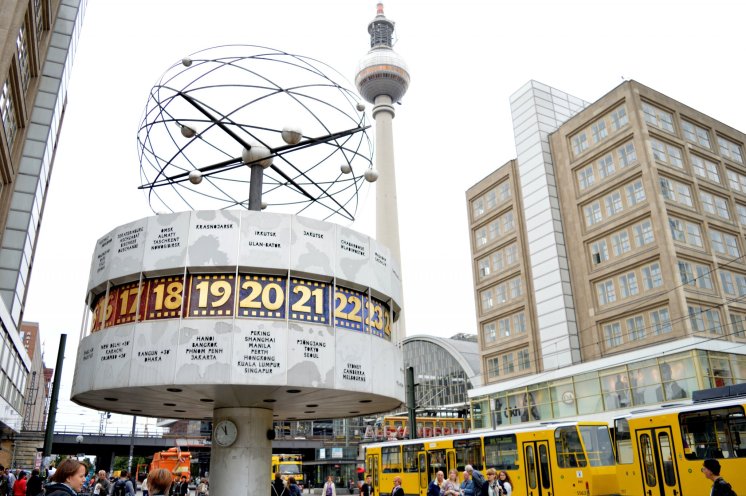
This stretch was intended as a showcase. It was where people were meant to shop, where the flats were a cut above the rest, and where the prestige buildings went up: Cafe Moskau, with a full-size replica of the Sputnik satellite, the Kino International, the Kosmos. The television tower at Alexanderplatz stays in view most of the way.
I had assumed Alexanderplatz was the centre of Berlin. It is a centre, not the centre. A city this size has several squares that matter, and Alexanderplatz is one of the busiest rather than the only one. Further along, near the square, I was glad to find the Nikolaisviertel, which a friend had told me about — it is said to be where the city began.
Crossing to the west
From there we took the S-Bahn across the city to the Hansaviertel, the centre of West Berlin. After the Second World War a group of prominent international architects was invited to build here, and they were given creative freedom rather than a party line. The result was meant to carry a message: freedom, independence, a Western capitalist society, expressed in concrete and glass.
We walked through the Tiergarten, the vast park at the middle of the city, while Lucia talked about the architecture and politics of the western half. Berlin has twelve districts, and what struck me is how self-contained each one is — its own markets, its own stations, its own places to eat. You could live a whole life inside one of them.
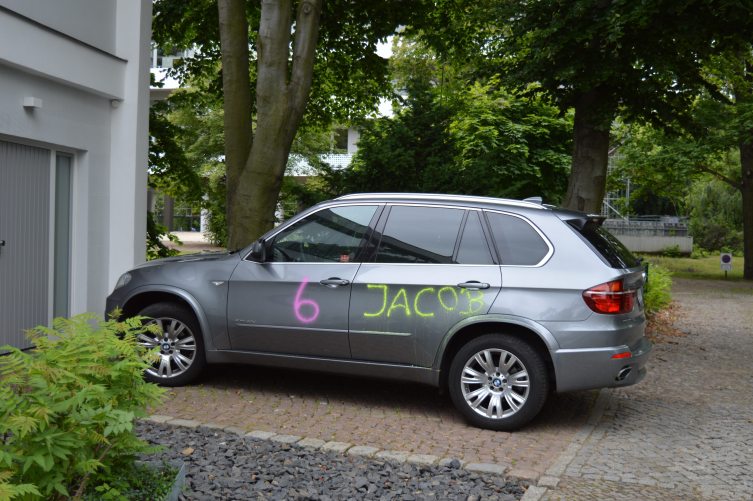
Somewhere in that area we kept seeing the number 6. On it, everywhere. The day before, I had heard about an artist who paints the number 6 on walls across Berlin, so naturally my mind went there. It was probably the work of local children, but it started a long conversation about street art and the people who make it.
The tour finished at the Academy of Art in the Hansaviertel, a short walk from Bellevue station.
Which side was better?
I could not answer that, and I don't think the tour was trying to. Some people who lived in the East liked the model they were given and still speak of it with affection. Some in the West were content with their own ideology and values. Both things can be true of the same city in the same decade.
One detail that reorganised my sense of the period: when the city was first divided, there was no Wall. It came later, in 1961. The division existed as a line on a map and a set of restrictions long before it existed as concrete.
Pieces of the Wall still stand. One stretch runs close to Berlin Ost Hauptbahnhof. It is hard to look at it and not think about the people who were shot trying to get over it. Outside the tour, I went to Checkpoint Charlie, the official crossing between the two Berlins, and stood there for a while. I had a great many questions. Lucia took all of them, from all of us, and answered them patiently.
On taking a guided tour at all
Most cities have walking tours, and most of them are fine for an overview before you set off on your own. If you want something more particular — the history, the culture, the architecture, explained by someone who studies it — a specialist outfit is worth the money. Context Travel runs tours in Europe, Asia and America, and this one changed how I read the city afterwards.
I was a guest on the tour, and the opinions here are my own.
Discover more from Europe Diaries
Subscribe to get the latest posts sent to your email.
Pingback:Things to do in Berlin
Pingback:Christmas markets in Germany - Europe Diaries
Ami Bhat
I think the best way to enjoy a city is to take a walking tour. Glad you could do that in Berlin. and I hope that one day I can do that too. 😀
2traveldads
I would love to explore Berlin and see the city for myself. The communist impact sounds like it’s still quite visible today and the architecture definitely shows it. Germany is one big mystery to me, especially with so much recent history influencing life today.
Vyjay Rao
Berlin is such a fascinating place and more so because of its history. It is really amazing to know about how life went on before the end of the cold war and the fall of the Berlin wall. How people lived behind the Iron curtain.
eulandas
Sounds like a well versed and intriguing tour! Berlin has always been on the list, but hearing about this tour is especially interesting. Thanks for sharing!
Heather
I have been to Berlin once and feel I barely scratched the surface. The layers of history go deep. I look forward to visiting again and learning more.
Pingback:5 things not to miss in Berlin - Wyld Family Travel
Pingback:The year that was:Europe Diaries 2015 | Europe Diaries:My travel stories and experiences
Pingback:City Tripping #3 - Wander Mum
Wander Mum
Berlin is such a fascinating place. I really enjoyed visiting – a few years back – and learning more about its history. It’s hard to believe the separation of the country is such recent history. Thanks for taking us on your walking tour with us … And for linking to #citytripping x
Rosie @Eco-Gites of Lenault
My father went through Check Point Charlie about a year before the wall came down and said the difference between the West and East was huge then.
Shobha George
Berlin looks lovely!
Carolann & Macrae - One Modern Couple
Definitely want to visit Berlin – so much history! Didn’t realize the division occurred prior to the wall! Guess there’s lots for us to learn one we visit!
Stacey Marlene Valle Macias
This is somewhere I would love to visit, learn more about the history and even listen to locals’ stories about it. I can’t imagine how people feeling when the wall was taken down. It must feel so liberating. Have you heard any personal story when the berlin wall was taken down?
connier316
I enjoy walking tours that give you a peek inside a city’s history. It’s especially nice when the guides grew up in the area and and share personal stories. A college degree can replace personal experience. It was nice to get Juergen’s perspective.
Simone Lye
I love walking tours ; would LOVE to visit Berlin 🙂 Loved your post!
Simone x
reflectiveponderer
Thanks so much,Simone! Do let me know if you visit Berlin!!
rosemaylily2014
I agree walking tours are a great way to get a feel for a new place. We also did several walking tours when we visited Berlin a couple of years back. It was a different company to the one you did, but again very knowledgeable guides and the history was fascinating. It was good to be able to put places in context with the overview tour and then we went back and visited the attractions we had found most interesting, best wishes Rosemary Le Chic En Rose #mondayescapes
Grietje from TravelGretl
Very interesting city from many points of view! Also from historical 🙂 Been here a few times, and love it that the city is a bit more widely setup than Amsterdam 🙂
TRISHA VELARMINO (@psimonmyway)
I haven’t been to Berlin, unfortunately. Will pass this info to my family who are frequently traveling Europe!
P.S. Great pics!
theglobewanderers
A walking tour sounds like a fab way to explore and get to grips with a city. I visited Berlin a fair few years ago but I’m definitely due another trip. This is on my list :). Great post!
Gabby
elizabeth
Berlin is one of those cities everyone loves. It has a unique place in history and a walking tour would be great to explore it. Thanks to Juergen for adding his perspective. I think it would be a great city to just wander around on foot. Full of things to find and people watch.
Kimberly Erin
I have spent about 12 months in Europe and somehow not made it to Berlin yet, but as I know it is overrun with amazing history, a walking tour of some kind would most definitely be on my to.do.for.sure. list
heather843
I’m not a city person but I did enjoy Berlin, such a mix of architecture all in together, with history and contemporary right next to each other. The tour sounds worthwhile, think we would’ve got much more out of our trip if we’d done something like that.
Chris
Interesting read. From what I understand, the wall was erected by the Soviets to stop the flood of residents fleeing to the West, so it’s possible that in general the other side of the wall was the preference… 😉
natalietanner
Interesting observations! I have only visited once and way too briefly. Need to go back!
MummyTravels
I love the sound of this tour – I last visited Berlin when I lived in Germany in the 90s and the wall had been down for less than a decade. It would be so interesting to see how things have changed, it now seems almost unbelievable that this happened in my lifetime. Thanks for linking up to #mondayescapes
aharonhadas
That is such a unique post to write about Berlin, well done!!
ankkuliini
I keep hearing lot of good things about Berlin! For some reason it has never been on my top to do list but I would be curious to see the sites you saw. And I would definitely go on a tour, I love taking guided (walking) tours in the cities I don’t know much about! Thanks for the tip 🙂
Tara Wilson Cannon
What an interesting read. How nice of Juergen to share his personal experience in the comments.
karla
Berlin is an interesting city and I love their walking tours. You learn a lot of history from it. We also joined something one night, it was set up, a game! We had to solve clues related to the history of Berlin in order to find the pub where we should all meet up. It was nice! 🙂 I liked Berlin a lot. Its a city that grows on you, the longer you stay, the more you will like it.
reflectiveponderer
That sounds so interesting! Would love to try it out!
Bryna
I used to study German in school, and learned a lot about the interesting history there. I’ve been wanting to see it in person ever since but haven’t had the chance yet. Thanks for the glimpse into Berlin, and also suggestions on the tour!
reflectiveponderer
Thanks Bryna. I loved Berlin and want to revisit the city soon!
whileimyoungandskinny
I did a walking tour where I learned all about the history and I also did an ‘alternative’ walking tour where we saw the city’s best street art and the areas where people were squatting. Really fascinating and I felt I saw both sides of the city.
reflectiveponderer
I took the alternative tour too and loved the street art! Am infact currently writing about it too:-)
Lily
Being die hard reader of Europediary blog I always wait on reading your reviews about cities and things to do and try to explore those places if I am there. This may come as silly but I recently visited Lake Como, Italy. The very first thought came in my mind was that I need to read on how you describe the beauty of the city which has splendid views, such architecture lavish villas, mouthwatering food, luscious wine, beach to swim, hills/mountains to hike all in one… I stumbled… could not find enough words
So its your reader requesting you if you have not already please visit como its must as the city’s beauty would be well deserved treat to your readers and to yourself
reflectiveponderer
Thankyou so much! That’s very sweet of you. I have been wanting to visit Como..hope to do it sometime soon:)
Vlad
Berlin is on my list and this walking tour sounds great, I’ll definitely consider it when I’ll visit. Thanks for linking up with #TheWeeklyPostcard 🙂
Paula McInerney
Berlin is definitely a place we want to explore and a walking tour is a great way to learn so much more
reflectiveponderer
Definitely! They are a great way to know a city closely!
Juergen | dare2go.com
Well, I used to live in (West-)Berlin during what you call the ‘cold war era’.
A few of my brief impressions and memories form that time:
a) it used to be quieter, much quieter. Despite over 2.5 million inhabitants you quite often met people you knew just by chance.
b) it helped a lot that each part of town had its own center, called ‘Kiez’, where you did your normal shopping, went for a coffee or a meal. It was like living in a much smaller town.
c) to visit friends in the North was a bid complicated: by road you had to drive a big semi-circle around the East, which jotted in right close to the Reichstag (Brandenburger Gate stood on the border). On public transport there were two subway lines crossing under East Berlin, where trains didn’t stop or slow down. Correction: they did stop at Alexanderplatz, where there was an immigration office for people visiting the east. All other stations were dimly lit and guarded by armed military personal (both German and Russian – to check up on each other).
d) to go to West-Germany proper involved a lengthy road trip of at 200 or more kilometers through the GDR. There you were only allowed to stop on the few approved rest areas, otherwise you couldn’t leave the highway anywhere. At each end were lengthy and sometimes harassing border checks.
e) when the wall fell you couldn’t do your normal shopping anymore. All people from the east came across, received their ‘greeting money’, and run straight to the next shop to buy all the yummy things they had been missing. For locals it was a pain, as day-to-day shopping suddenly meant standing in line for half an hour to be let into a supermarket with empty shelves (and then try the next one)…
reflectiveponderer
Thankyou so much for sharing your experience and thoughts here, Juergen. I highly appreciate it. I really wanted to know what people must have truly felt like at the time of the division, and this was such a deep insight into it. I had heard that the trains slowed down at one point, but didn’t know that one would have to drive 200 kms to visit West Germany!
trippintwins
Berlin is a great city to explore history from. The walking tours available are great. It seems like a city you can never cover everything in, which makes it easy to want to revisit.