
Eight Swiss Stories, from the Basilisk of Basel to the Belalp Witch
This series began with a question. During Fasnacht one year I started asking friends what the Basilisk was, and the answers led me into a set of stories I had never heard. I read up on them, and the result is the post below: a handful of myths and legends from Switzerland. If you know others, tell me. I plan to take a different country each month, and you are welcome to get in touch if you would like to contribute.
The stories run from Basel to the high valleys, and several of them are still performed rather than merely told.
Basel, in two creatures
The Basilisk
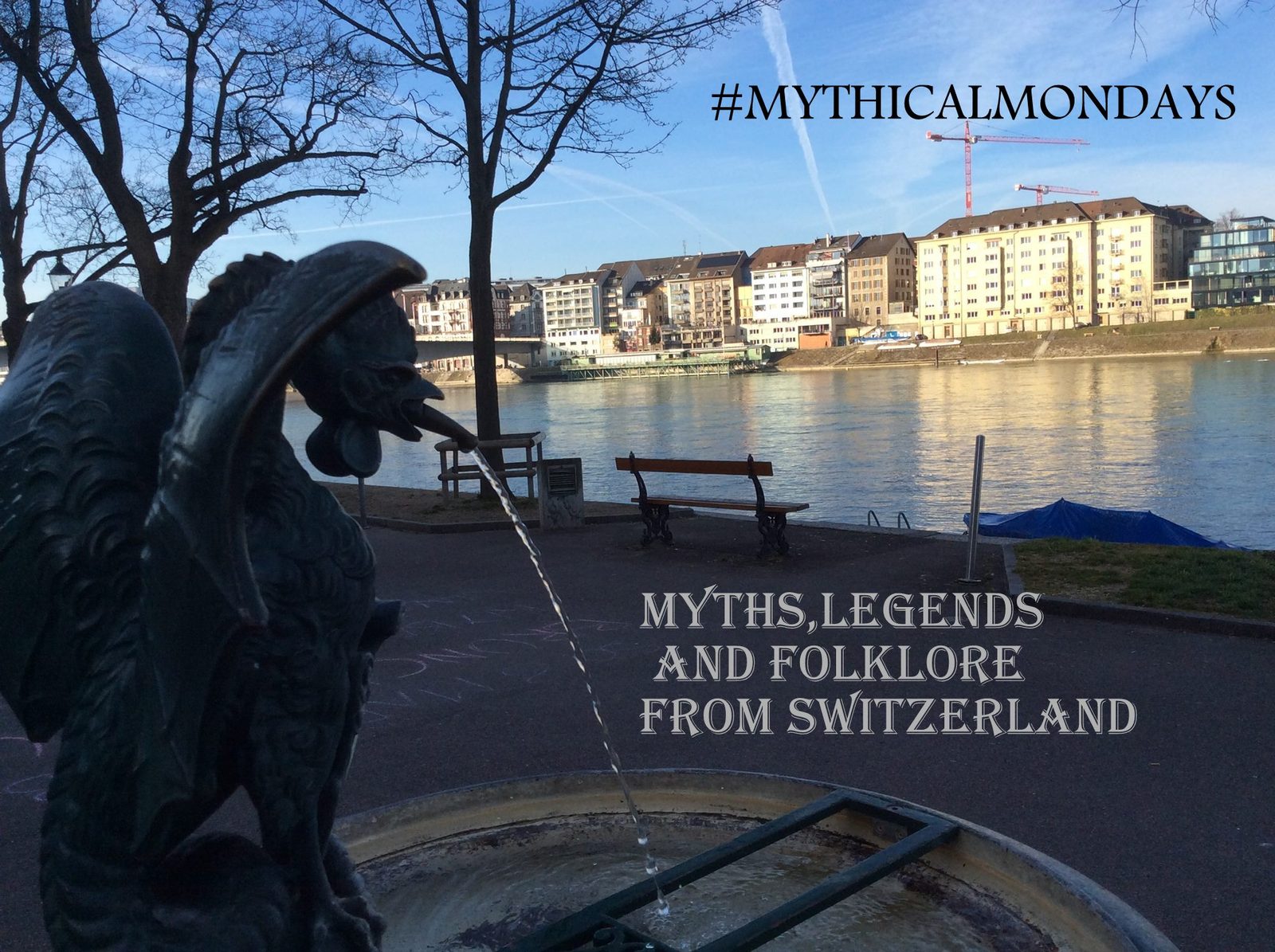
Walk around Basel and the Basilisk is hard to miss. The creature appears on fountains and statues, part dragon and part snake, and the story behind it goes back to the 1400s. It was said to be so poisonous that a single glance could kill. The Greek word basileus means king, which may be why it was called the king of snakes. It was supposedly born when a cockerel laid an egg that a snake then incubated.
As unlikely as that sounds, the Basilisk turns up in plays, stories and, more recently, in Harry Potter and the Chamber of Secrets. It was imagined as a small dragon with a snake's tail and a cockerel's head, walking upright rather than gliding, and able to kill the grass it crossed. The only way to destroy it was to show it its own reflection.
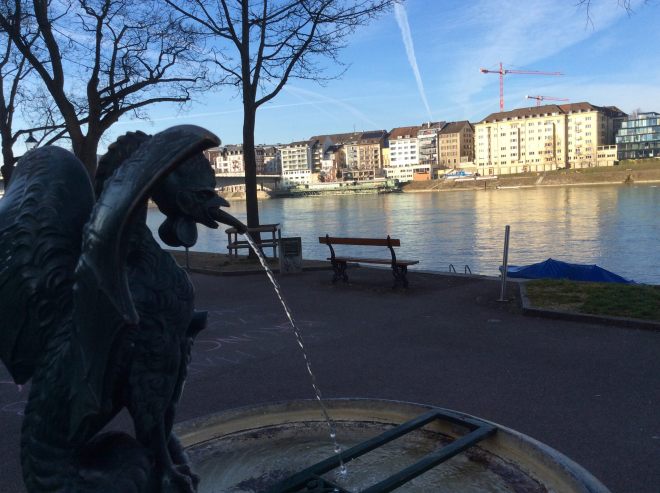
A Basilisk fountain along the Rhine in Basel. Picture: Souvik Ghosh.
The creature has been a symbol of Basel for at least 500 years and still holds the city's coat of arms. On the monument to the earthquake that destroyed the city in 1356, the epitaph reads: "Basilisk, you poisonous worm and fable, now you shall hold the shield of the dignified city of Basel."
Vogel Gryff
Basel keeps another tradition that few visitors see. On one afternoon in January, three figures belonging to the societies of KleinBasel meet on the Mittlere Brücke and dance facing KleinBasel: the Wilder Mann, a savage man; the Leu, a lion; and the Vogel Gryff, a griffin. The city is divided into Gross, meaning large, and Klein, meaning small. The societies once had political functions; in 1841 they moved into the same building and began holding a joint celebration every year. Switzerland Tourism has more on its website.
Central Switzerland: an apple and a bridge
William Tell
Most people know the outline: a man forced to shoot an apple from his son's head. The story is set in Uri, in central Switzerland. A tyrannical bailiff called Gessler ordered people to bow to his hat, mounted on a rod, whenever they passed it in the street. Tell refused. He was taken prisoner and made to attempt the shot. He had a second arrow ready for the bailiff in case his son was harmed, but his aim held. Later he killed Gessler.
Historians have argued for centuries about whether Tell existed. What is not in doubt is what he became: a symbol of liberty, invoked in times of war and revolution, and a central figure in Swiss self-understanding. The William Tell Museum is in Bürglen in Uri, where the legend places his home, and there is an open-air theatre production of the story at Interlaken.
The Devil's Bridge
The Teufelsbrücke crosses the Schöllenen Gorge in central Switzerland. Building it was so difficult that, according to the myth, the Devil offered to do the job himself — on condition that he received the soul of the first creature to cross. When the bridge was finished, the locals sent a goat over it. Furious at being tricked, the Devil set out to smash the bridge and fetched a huge boulder, the Devil's Stone. On the way he met a woman carrying a cross, took fright, dropped the stone and fled. The stone is still pointed out near Göschenen.
Above Lucerne: dragons and a ghost
Mount Pilatus, near Lucerne, is a busy tourist mountain with a strange set of stories attached. One legend places dragons with healing powers in the crevices of the rock. Another tells of a young cooper who was stranded on the mountain and survived the winter in a dragon's cave. A third concerns Pontius Pilate: his body was said to have been sunk in the Oberalp lake on the mountain, after attempts to sink it in various rivers had failed. Pilate's ghost was blamed for the thunderstorms in the area, and was believed to rise every Good Friday "to wash the blood of Christ from its hands". In the end, the story goes, he found peace at Pilatus.
High valleys: a witch, some dwarfs and a girl called Heidi
The witch of Belalp
Witch trials were common across Europe in the Middle Ages, and one case in the Belalp region is still remembered. A woman there was accused of causing her husband's death and was burned at the stake. Today the story is marked by a week-long skiing event in Belalp every January, when people dress as witches and wear masks for the 12-kilometre Witches' Descent, and the cry of "D'Häx isch los!" — the witch is loose — goes up on the slopes.

Getting ready for the Witches' Descent at Belalp. Picture: Acecabana.
Christina Pfeiffer, writing at traveltherenext.com, gives the fuller version. A witch married to a pious man fell in love with a sorcerer, and the pair turned themselves into black ravens whenever they wanted to meet. One day, boiling soup in a cauldron at the top of the Aletsch glacier, the witch found she had run out of garlic and raced down to her herb garden. On the way she spotted her husband high in a cherry tree, picking fruit. She became a raven and flew up to greet him. At that moment he turned his face to the sky to say his afternoon prayers, and the bird dropped its droppings into his eye. Blinded, he fell from the tree and died at once. The village authorities accused the witch of casting a spell with her cauldron and burned her at the stake. Centuries later the Belalp ski club founded the Belalp Hexe in her memory, and the finish line of the race is said to be the very spot where the pious husband fell.
The earth-men
The dwarfs of Switzerland, also called the earth-men, were said to be lively, helpful and kind. Their main work was rearing chamois, a kind of cattle whose milk made a particularly good cheese. This cheese had the property of growing back after being cut, provided the owner remembered to leave a piece at the end so that it could sprout again. More of these stories can be found on this website.
Heidi
Heidi is not a legend but a novel, written in 1880 by Johanna Spyri, about a girl in the Swiss Alps. Films and cartoons have been made from it, and both the book and its adaptations have travelled far beyond Switzerland.
When to see them
- January: Vogel Gryff in Basel, and the Witches' Descent at Belalp.
- Fasnacht, before Lent: the moment the Basilisk question first came up, and the best time to see Basel in costume.
- Summer: the open-air William Tell production at Interlaken.
- Any time: the Basilisk fountains along the Rhine, the Tell museum at Bürglen, and the Devil's Stone near Göschenen.
That is the set I started with. If you know a Swiss story I have missed, send it my way — and if you would like to write about the folklore of your own country for the series, get in touch.
Discover more from Europe Diaries
Subscribe to get the latest posts sent to your email.
Pingback:Myths,legends and folklore from Germany - Europe Diaries
Pingback:Legends from around the world that bring you good luck | Europe Diaries:My travel stories and experiences
Anna
Love this! Especially the Basilisk tale. My previous familiarity with it was exclusively by the way of the Chamber of Secrets 😉
reflectiveponderer
Mine too!! Had no idea that JKR was inspired by the actual mythical Basilisk. .which is supposed to have existed in my city!!